
I was watching Super Formula with The Guys tonight.
It was at Fuji Speedway this weekend, and there was a shitton of fog and rain.
It was too dangerous for the safety helicopter to take off, so they were delaying the race
(it ended up being cancelled later).
While the TV network was filling time, they were doing interviews with all of the drivers in Japanese.
The English broadcast was just airing the full audio of the interviews, but wasn't translating them.
(Or maybe they were in the closed captions, but we were ...
sailing the seven seas so to speak, so we couldn't see the captions if they were lol)
My friends start asking me to translate for them. I did what I could. It was mostly just the drivers talking about
Ah I'd really like to race today, it's gonna be a challenge with all the rain."
"Thank you guys for all of the support, please look forward to us fighting out hardest out there!"
Stuff like that. I roughly understood about 30% of what they were saying.
I realized that one area I've gotta work on is listening to, like, old Japanese men.
Whenever they spoke, I couldn't understand a thing...
Today is a Thursday, this week I've not really done too much formal reading.
I was watching my favorite Japanese streamer (Sora The Troll) this week though for input/output practice.
It was pretty funny. There was this one guy in chat acting stupid, and the streamer was calling him out.
I said in chat:
「十四歳じゃない?」
"Isn't that guy 14? lol"
Sora started laughing. +2.
It's fun to type in Japanese in his chat because it's mostly an English stream, but he's a Native Japanese speaker,
so sometimes he'll just talk to the Japanese viewers directly.
It's fun to listen to him order, like, food or something because
I can tell chat what he's doing before chat can respond. It's like a secret code.
But not really since a lot of the English viewers also speak Japanese lmao.
This week was kind of crazy in terms of stuff OUTSIDE of Japanese studies.
I didn't do too much except read a couple posts on Bakusai.
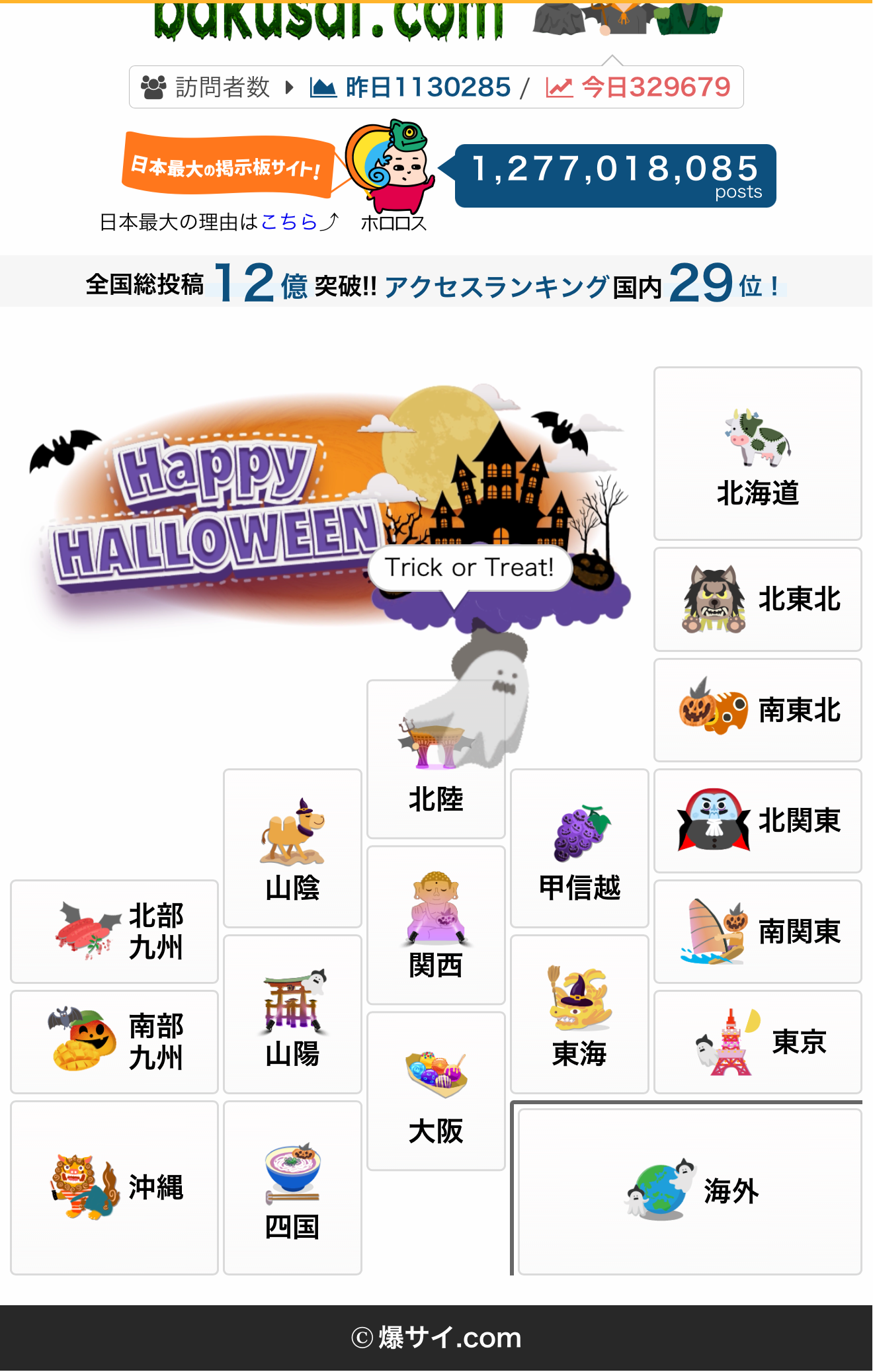
They were doing some kind of Halloween event.
This is my first year of crawling Bakusai, so I didn't know that they did special site themes
and icons for Halloween.
By the way, if you were curious, my favorite kanji is
(hone). It means "bone". Isn't that great?
It's a kanji that means bone and looks like a skeleton, and it's super easy to remember,
because hone + ゛ (a dakuten) turns the pronunciation into "bone"!
One of my favorite things is "Slime". My online name is "Slimebiter".
The kanji for slime is basically just the "bone" kanji + the radical for water:
One of the easiest ways to recognize the water radical, is if it's on the left side, it'll just look like 3 water droplets. Apparently, the reason why "slime" looks like "bone + water" is because the bone character "huá" apparently was pronounced the same as "slippery" in Chinese. Several sources (Google Gemini lol) say that the bone element was just "representative of something smooth, like a bone", which is a good way of thinking about it for rote memorization purposes; but the actual reasoning is much more interesting to me lol.
So, I also decided to look at other blogs in Japanese for some ideas... And I disovered "HatenaBlog". I spend a lot of time as a kid on Blogspot reading random stuff and learning new things, so I thought it would be fun to try and translate a couple blog posts for myself. I found one that seemed pretty interesting: 晴れ女と行く、秋の瀬戸内ふたり旅 (Going on an Fall trip with the sunshine lady to Setouchi)
Over the weekend I did something kinda fun. I wanted to try attending an ikebana class at the Japanese Culture Center here in Chicago.
I knew what ikebana was, of course, but just that. I only knew the name and roughly that it had something to do with flower arrangements.
The school of ikebana I was taught over the weekend is called "Ohara-ryū", and it actually ended up being very interesting.
The teacher found out I spoke Japanese when I accidentally answered 「はい」to one of here questions while she was explaining something to me.
It was cool, but then she spoke to me in Japanese 75% of the time for the rest of the class. It was actually really scary lol.
But... I was really glad to get the chance to speak with a native speaker it told me that I have a lot more learning to do,
but that I was also not as bad as I thought I was. Sensei remarked to the rest of the class "I'm so sorry that I'm speaking Japanese with Cosmic",
and one of the students replied "No, no, it's a beautiful language." ... I... didn't think my Japanese was very beautiful LOL, but it was nice
to hear someone say that, too.
Anyways...
Back to the matter at hand... I actually forgot to take photos of each of the steps as we did them, but I have a photo of the first step.
One of the other students actually had a textbook for Ohara-ryū, which was quite interesting. I might try to see if I can find one somewhere.
I do not remember the steps off the top of my head, but I do remember the flowers! (crysanthemum, gayfeather flower, and hypericum)
To start, we were given a vessel (a long, and shallow pot), and an instrument called a "Kenzan" 「剣山」(literally the sword + mountain kanji).
The kenzan I have is basically a metal instrument with a bunch of spiky pins that you push the flower stems onto for arranging.
Um... It kinda hurts your fingers,
I won't lie. 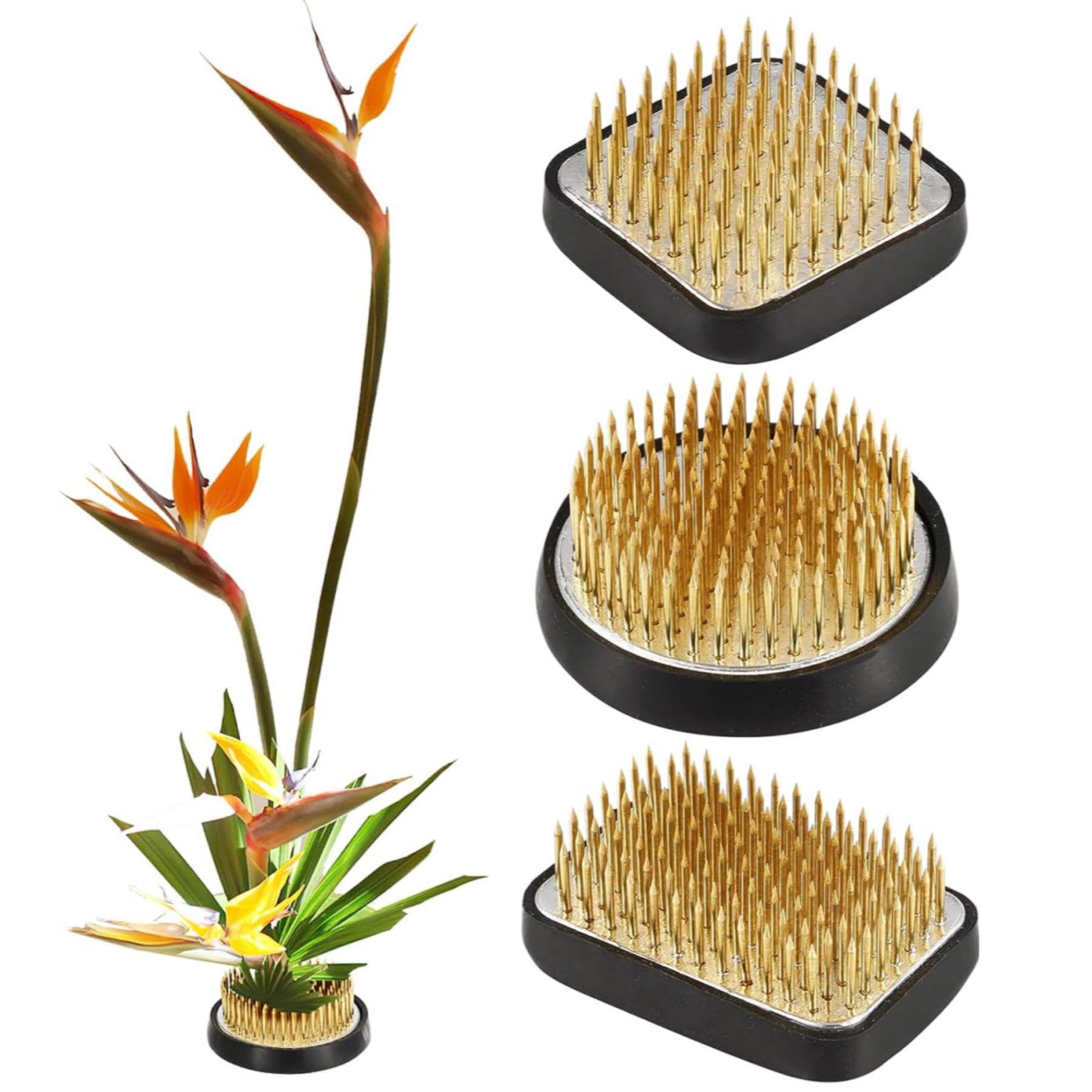 (Image stolen from Amazon.com lol).
We were given a few flowers and were instructed on how to place the flowers for arrangement.
(Image stolen from Amazon.com lol).
We were given a few flowers and were instructed on how to place the flowers for arrangement.
We started with the gayfeather flower (liatris spicata). In this image you can see the kenzan (bottom left of the vessel), the liatris spicata
(purple tall flowers with thick stems) and my vessel, an ovular shapped shallow dish made out of ceramic.
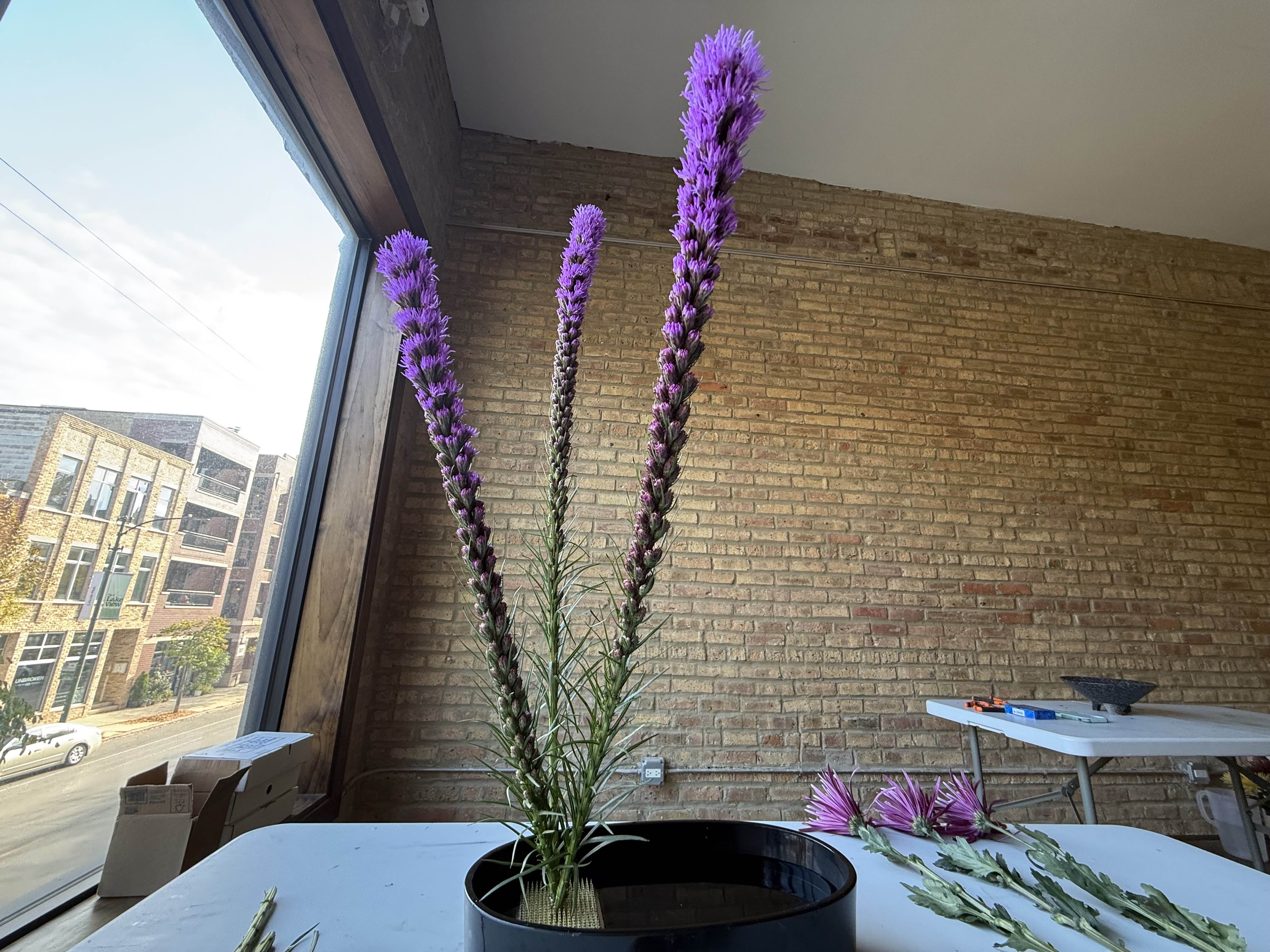
Afterwards, we went through the rest of the steps. We added the crysanthemums, and used them to cover the kenzan from view. Then we added the hypericum and it was also used to finish covering the kenzan as well.
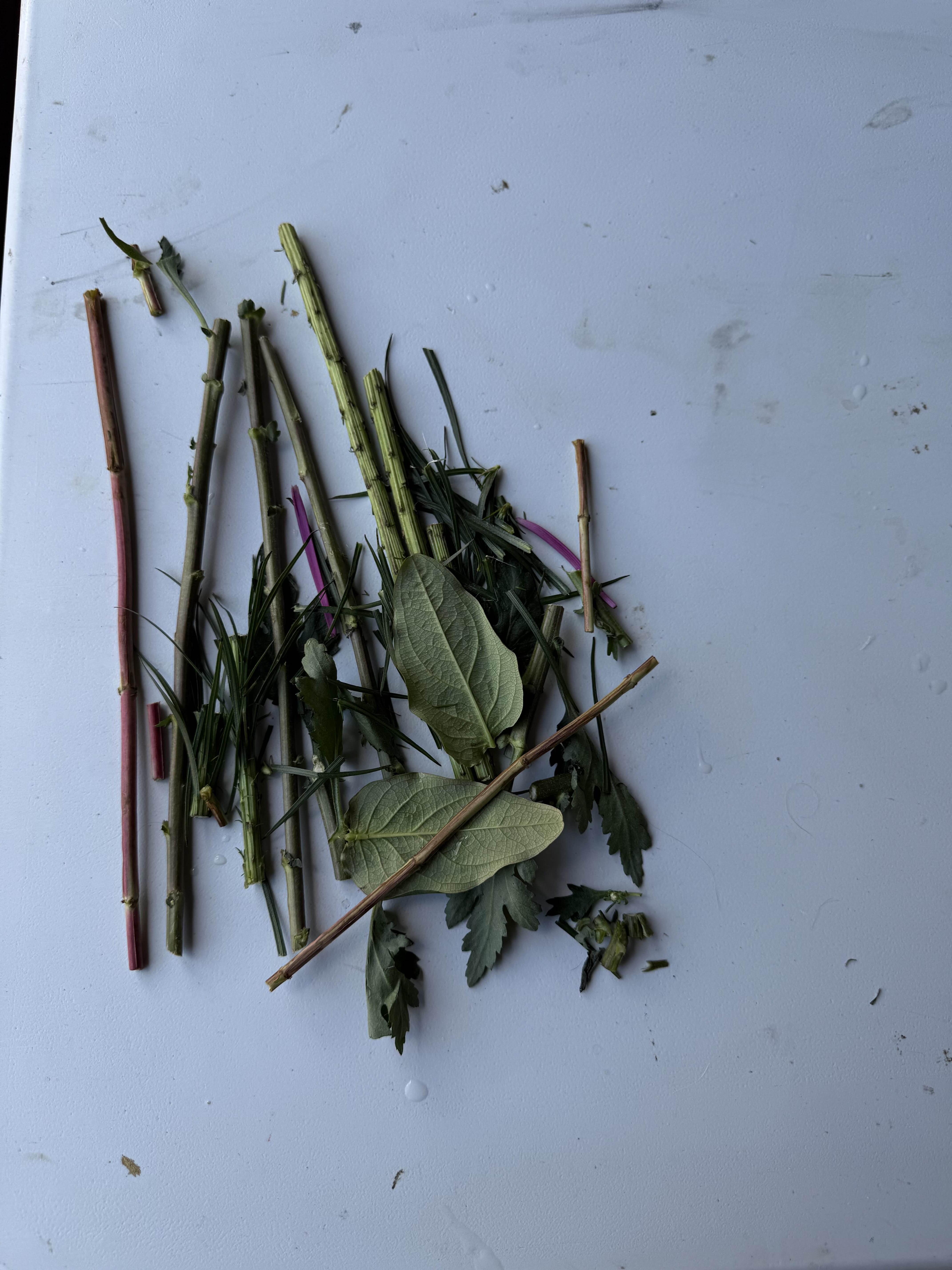
At the end of class, I came away with quite a few cut stems, leaves, and flower petals. I kept them all in a neat pile for easy disposal.
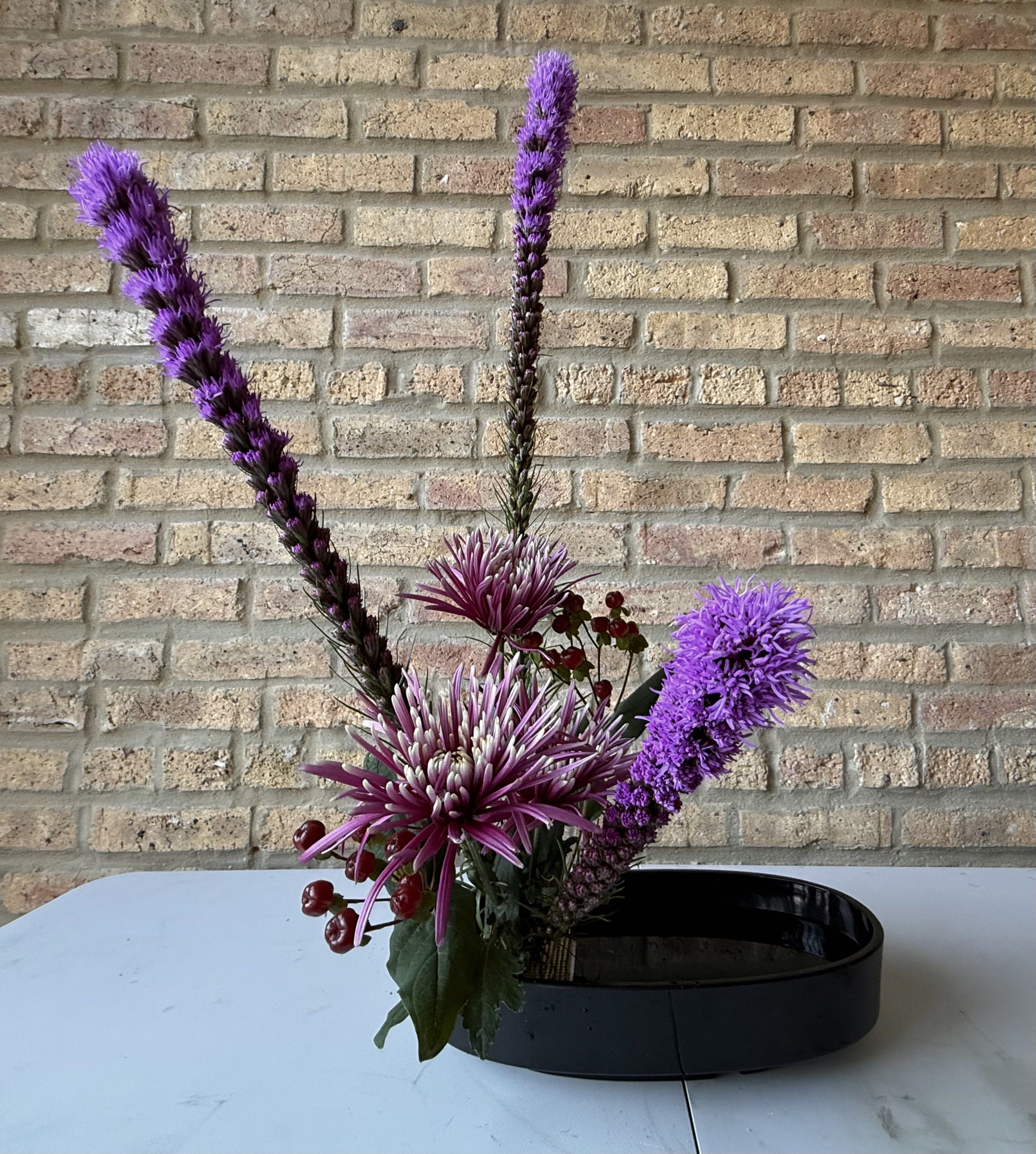
This is what it looked like at the end of class. I really loved the 3-dimensionality of it. I accidentally cut one of my chrysanthemums
too short, and I got a little upset about that... But it was my first time trying ikebana, so if I was gonna make a mistake, it's good that
it was only the first class.
I had to take apart my arrangement before going home, and I had to redo it at home.
All things considered, I think I did a good job rearranging everything.
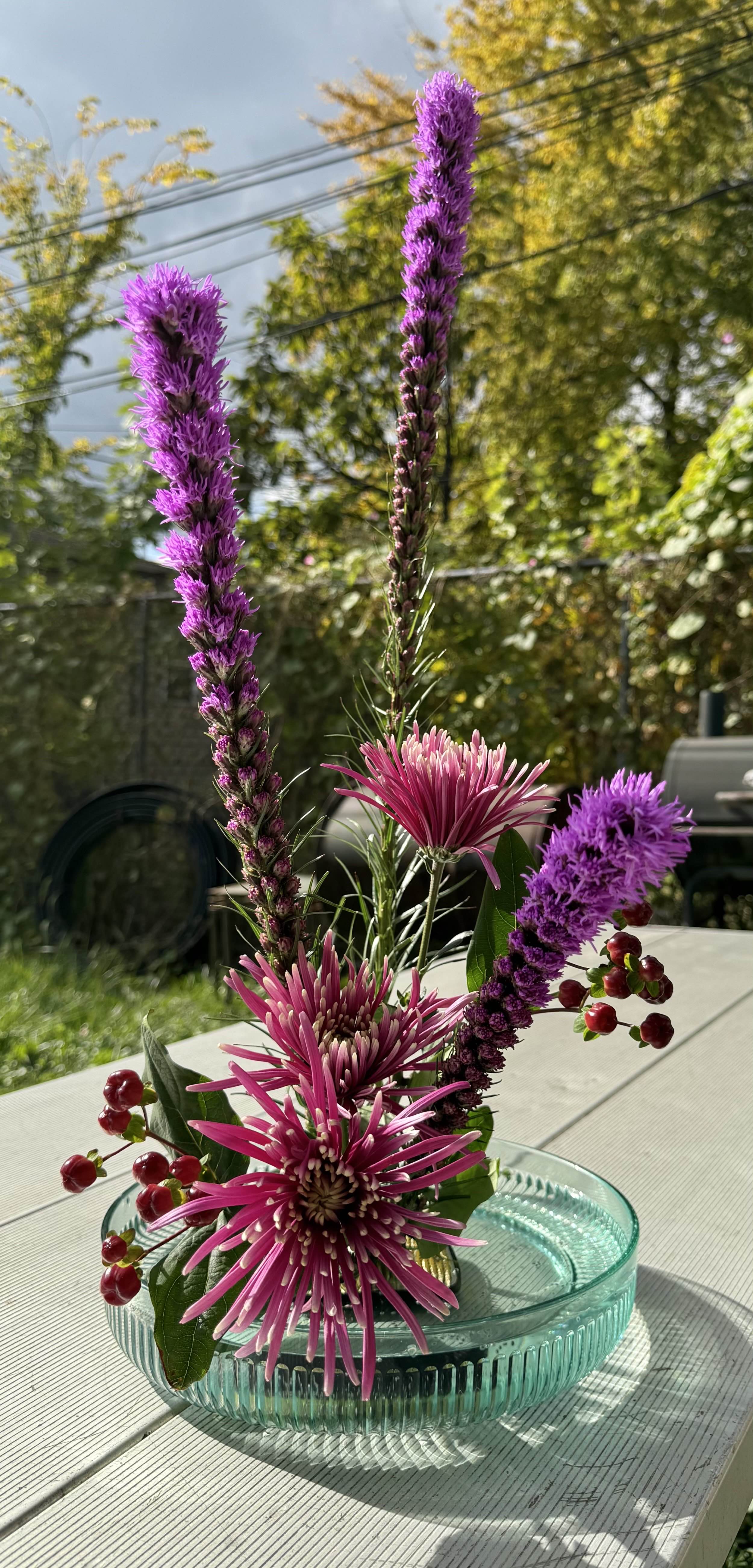
One of my favorite materials to look at is glass. I enjoy playing with transparency and reflections and light. I'm quite pleased that my arrangement looks this attractive in a glass dish.